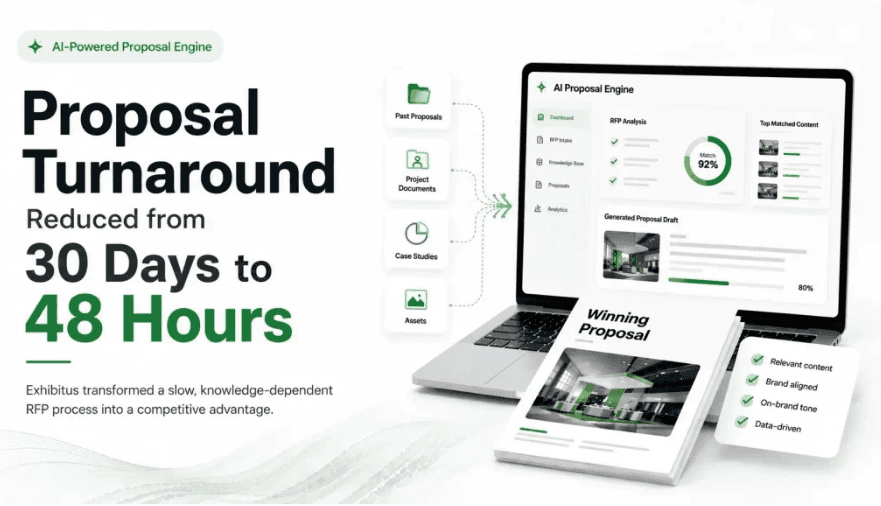
Using AI to Produce RFPs and Estimates Faster

Using AI to Produce RFPs and Estimates in 2 Days, Not 3 Weeks
Exhibitus, an events and experiential marketing company, used RFP automation with AI to cut its proposal turnaround from more than three weeks to around two days, at 78% lower cost per response. The work didn't start with AI. It started with a two-day discovery workshop that mapped how the business actually worked, and found the answer sitting in the process that brought all the money in.
The Problem
Exhibitus was growing, and growth put pressure on the one process that brought new work in.
Every opportunity arrived as an RFP. Answering it meant pulling content, pricing, technical detail, and past project history out of people spread across the business. Each response took more than three weeks and occupied [N] people who should have been serving clients.
The real cost was not time. It was choice. When a single response costs three weeks, you stop pursuing every opportunity worth pursuing. Growth becomes limited by the capacity to bid, not by the size of the market.
So Exhibitus asked the question most leadership teams are now asking: where could AI actually help?
Before We Started
RFP responses took more than three weeks and tied up [N] people across functions.
Knowledge lived in individual heads and inboxes, so every response meant chasing the same content, pricing, and project history again.
Manual hand-offs connected every team, with no system coordinating them.
No one had a complete, end-to-end view of how the business worked. Each function understood its own part. Nobody owned the whole.
Everything in this case study was built from that starting point.
What We Built: RFP Automation with AI and a Scalable Operating Model
What We Did First, and It Was Not AI
Most AI programs start with the technology and go looking for a problem. We started with the business.
We ran a two-day AI readiness workshop with teams from every function in one room. We mapped how work entered the business, how information moved between teams, where decisions were made, and where manual effort was creating delay.
One finding mattered more than the rest:
No one inside the business had a complete, end-to-end view of how it actually worked.
That isn't a criticism. It's normal. Every function understood its own part clearly, but nobody owned the whole, and the waste was sitting in the joins between teams, where no single team could see it.
We captured the full picture in a service blueprint and put it on one wall. That changed the conversation. It stopped being a debate about AI tools and became a debate about where the money was leaking.
From a Map to a Ranked ROI Roadmap
The workshop produced more opportunities than any company should take on at once. We tested each one against five questions:
How much time does this process consume today?
What does that cost the business?
What happens to that cost as the company grows?
Can technology materially change it, or only decorate it?
How quickly can we prove the value?
The last question does most of the work. Opportunities that take a year to show a result are hard to fund and easy to kill. Opportunities that pay back in weeks fund the next one.
The recommendation was deliberately unambitious: start with the highest-value process we could change quickly, prove the impact, reinvest, and scale what works.
The RFP process came out on top. It wasn't the most interesting problem in the business. It was the most expensive.
Three Weeks to Two Days
We did not automate the existing process. Automating a bad workflow just produces waste faster.
We redesigned the workflow first, then applied AI where it removed genuine effort: retrieving knowledge held across the organization, assembling and drafting content, and cutting the manual coordination between teams.
A response that took more than three weeks now takes around two days. Commercially, that means:
The cost of every bid falls.
Senior time goes back to clients, creative work, and delivery.
Exhibitus can pursue more opportunities without growing headcount at the same rate.
The point was never speed for its own sake. It was capacity. Exhibitus built capacity ahead of growth rather than hiring in response to it.
From One Automation to a Scalable AI Operating Model
The RFP process was the start, not the program.
Over the following nine months, we worked through the rest of the roadmap. Five large processes were redesigned or automated. Manual hand-offs were removed. Knowledge that lived in individual heads and inboxes was made accessible to everyone who needed it.
Each initiative was tied to a business outcome before it started and measured after.
Not everything on the roadmap was built. Several opportunities were parked because the return didn't justify the effort, and one was dropped after we tested its underlying assumption and found it didn't hold. Deciding what not to build saved as much as the automation delivered.
Results
Exhibitus now responds to opportunities in days rather than weeks, at materially lower cost, with more organizational capacity than it had a year ago.
Metric | Before | After |
RFP turnaround | More than 3 weeks | Around 2 days |
Cost per RFP response | Baseline | 78% lower |
Processes redesigned or automated | 0 | 5 in 9 months |
Discovery to ranked ROI roadmap | N/A | 2 days |
More importantly, the shape of the business changed. Revenue can now grow without operational cost and complexity growing at the same rate.
What We Learned
Start with the business, not the technology. The most valuable output of the engagement came before any AI was applied: a single end-to-end view of how the business worked. The waste was in the joins between teams, and no tool would have found it on its own.
Redesign before you automate. Automating a bad workflow just produces waste faster. The RFP process got faster because it was redesigned first, and AI was applied only where it removed genuine effort.
Pick the fastest payback, not the most interesting problem. The RFP process won because it was the most expensive, not the most exciting. Quick, measurable wins fund the next initiative.
Deciding what not to build is part of the work. Parking low-return opportunities and dropping one that failed its assumption test saved as much as the automation delivered.
Glossary
RFP (Request for Proposal): A formal document a prospective client issues to invite companies to bid on a project, usually requiring pricing, technical detail, and relevant past work.
AI readiness workshop: A structured session that maps how a business operates today to identify where AI and automation can create measurable value, and where they can't.
Service blueprint: A diagram that maps every step of how a service is delivered, including the people, systems, and hand-offs behind it, so teams can see the whole process rather than just their part.
Operating model: The way a business organizes its people, processes, and technology to deliver its work. A scalable operating model lets revenue grow faster than cost.
ROI roadmap: A ranked plan of improvement opportunities, ordered by expected return and how quickly each can prove its value.
Hand-off: The point where work passes from one person or team to another. Manual hand-offs are a common source of delay and lost information.
Frequently Asked Questions
What is an AI readiness workshop?
How long does it take to identify where AI can help a business?
How does RFP automation with AI reduce turnaround time?
Should you automate a process before redesigning it?
How do you decide which business process to automate first?
The Takeaway
AI created value at Exhibitus for one reason: it was pointed at the right problem.
The shift wasn't a faster RFP. It was a scalable AI operating model, where revenue can grow without cost and complexity growing alongside it, built by mapping the business first and automating second.
Where is the three-week process in your business?
Most leadership teams can name it. Very few have quantified it. A two-day discovery workshop gives you a mapped end-to-end operating model, a ranked list of opportunities, and a clear view of which one pays back first.