AI
AI Video Generation
Guide
Design
Digital
Digital Transformation
Industry News
Marketing
User Experience
Technology Consulting
Share
Which AI Voice Platform Actually Wins in 2026?
The voice AI space moved fast this year. Two platforms keep coming up in every serious builder conversation: ElevenLabs and Cartesia. They're not really competing for the same thing, which is exactly why so many teams pick the wrong one.
This is for you if you're building a voice product, running a podcast workflow, adding speech to an AI agent, or evaluating TTS providers for a production app. If you just want a quick demo, both have free tiers. If you're deciding where to route real traffic, keep reading.
Key Terms to Know Before We Compare
Core Tech Stack
TTS (Text-to-Speech) - converts text into spoken audio; the "output voice" layer. Both ElevenLabs and Cartesia are TTS platforms at their core.
ASR (Automatic Speech Recognition) - converts spoken audio into text; also called STT (Speech-to-Text); the "listening" layer. ElevenLabs offers this via Scribe v2; Cartesia offers it via Ink Speech-to-Text.
LLM (Large Language Model) - the reasoning/response brain in the middle (GPT, Claude, Gemini, etc.). Neither platform provides this; you bring your own.
VAD (Voice Activity Detection) - detects when a user starts or stops speaking; critical for knowing when to interrupt or respond in real-time agents.
Latency & Performance
TTFA (Time-to-First-Audio) - how long until the first audio chunk plays; the latency metric that actually matters for real-time feel, not total generation time.
End-to-End Latency - total delay from user finishing speech → agent responds; the sum of ASR + LLM + TTS latency. TTS is one piece of this.
Streaming - delivering audio/text in chunks rather than waiting for full generation; essential for low TTFA and conversational feel.
Interruption Handling / Barge-in - the agent's ability to stop speaking when the user talks over it; a make-or-break feature for real-time voice agents.
Voice & Identity
Voice Cloning - training a model on someone's voice recordings to replicate it. Both platforms offer this, with different quality trade-offs.
Instant Clone vs. Professional Clone - short-sample cloning (seconds of audio) vs. high-fidelity cloning from 30+ minutes of audio. ElevenLabs leads on Professional Clone quality.
Voice Design / Synthetic Voices - AI-generated voices not based on a real person; useful when you want a unique brand voice without cloning anyone.
Architecture
Turn-taking - managing the back-and-forth rhythm of conversation; harder than it sounds and critical to whether a voice agent feels natural.
Duplex / Full-Duplex - whether the system can listen and speak simultaneously (like a real conversation) vs. alternating turns. Full-duplex is the goal for real-time agents.
Telephony Integration - connecting voice agents to phone networks (SIP, PSTN) via platforms like Twilio or Vonage. Both platforms support this through integrations.
Orchestration Layer - the middleware that coordinates ASR → LLM → TTS (examples: Vapi, Retell AI, LiveKit, Pipecat). Both platforms integrate with these.
Quality & Evaluation
MOS (Mean Opinion Score) - the standard 1–5 scale for rating voice naturalness. Used in independent evaluations to compare platforms.
WER (Word Error Rate) - how often ASR transcribes words incorrectly; a key quality metric for the listening layer.
Hallucination - when the LLM generates confident but wrong information; especially risky in phone agent contexts like healthcare and financial services.
Company Profiles
ElevenLabs
Founded | 2022 |
Headquarters | London, UK (offices in New York, Warsaw, San Francisco, Tokyo, Bangalore) |
CEO | Mati Staniszewski (co-founder) |
CTO | Piotr Dąbkowski (co-founder) |
Employees | ~580–880 (2026, sources vary) |
Total Funding | ~$781M–$850M |
Valuation | $11B (February 2026 Series D) |
ARR | ~$500M (Q1 2026) |
Key Investors | Sequoia, a16z, Lightspeed, ICONIQ, Salesforce Ventures, BlackRock, Nvidia |
Notable Customers | Washington Post, TIME, HarperCollins, Deutsche Telekom, Revolut, Klarna, Square |
Enterprise Penetration | Used by employees at ~60% of Fortune 500 companies |
Industries Served | Media, gaming, publishing, customer service, healthcare, legal, financial services, accessibility |
ElevenLabs was founded by two Polish friends, Mati Staniszewski (ex-Palantir) and Piotr Dąbkowski (ex-Google), after they were frustrated by the quality of dubbed American films.
Their platform has grown from a text-to-speech tool into a full audio AI stack, and in February 2026 closed a $500M Series D at an $11B valuation led by Sequoia Capital. Enterprise revenue now accounts for more than 51% of total revenue, with their Eleven Agents product being the fastest-growing offering.
Current product suite:
Pillar | Description | Products |
Content creation & audio production | Text to Speech · Speech to Text · Voice Changer · Text to Sound Effects · Voice Cloning · Voice Isolator · AI Music Generator · Studio · Voice Design · AI Voice Generator · AI Image Generator · AI Video Generator | |
Conversational AI & voice agent deployment | Voice Agents · Conversational AI · Integrations · Chatbots · Customer Support · Verticals: Telecom · Financial Services · Healthcare · Technology · Retail & E-commerce | |
Developer access to the full model stack | Agents API · Text to Speech API · Speech to Text API · Dubbing API · Sound Effects API · Music API · Speech Engine · API Reference |
Source: https://elevenlabs.io/about
Cartesia
Founded | 2023 |
Headquarters | San Francisco, CA (Bay Area) |
CEO | Karan Goel (co-founder) |
Co-Founders | |
Employees | ~50–116 (2026, sources vary) |
Total Funding | ~$191M |
Key Investors | Kleiner Perkins, Index Ventures, Lightspeed, Nvidia, ICONIQ |
Notable Customers | Quora, Daily, Maven AGI, 11x, Together AI |
Industries Served | Customer service, healthcare, gaming, logistics, enterprise voice agents |
Cartesia spun out of Stanford's AI Lab. The founding team - Karan Goel and Albert Gu, are the researchers behind State Space Models (SSMs), the novel AI architecture that powers their speed advantage.
Rather than using the transformer architecture that most LLMs run on, SSMs process sequences far more efficiently, enabling the sub-100ms latency that is Cartesia's core differentiator. In October 2025, they raised $100M and launched Sonic-3. The company is small, focused, and API-first by design.
Current product suite:
Sonic-3 (TTS)
Sonic Turbo (ultra-low latency TTS)
Ink (Speech-to-Text)
Line (voice agent platform)
Voice cloning
Voice design.
Source: https://cartesia.ai/company
What These Platforms Actually Are
ElevenLabs is a full-stack audio AI platform built on best-in-class speech synthesis. It started as a TTS and voice cloning tool and has expanded into speech-to-text, conversational AI agents, audiobook and dubbing workflows, and now music generation. It's the broadest platform in the space, with a product suite designed to serve both creators and enterprise builders.
Cartesia is a developer-first voice AI company built on a fundamentally different architecture. Its State Space Models give it a speed advantage over transformer-based competitors, and everything it ships is optimized around that core: ultra-low latency, real-time streaming, and clean APIs for agent builders. The product surface is narrow by design, Cartesia wants to be the best TTS/STT engine in your stack, not the whole stack.
If ElevenLabs is about quality and breadth, Cartesia is about speed and efficiency. Both matter. The question is which one matters more for what you're building.
Why This Decision Matters Right Now
Voice is becoming the default interface for AI agents. Customer support bots, AI phone systems, real-time tutors, voice-driven mobile apps. The TTS layer used to be an afterthought. Now it's the thing users actually experience.
Pick the wrong provider and you get either a beautifully crafted voice that arrives 800ms too late to feel conversational, or a lightning-fast response that sounds slightly off and kills user trust. Both are bad outcomes. They just fail in different directions.
The Core Argument: Speed vs. Richness
Here's the honest take. Cartesia wins on latency, period. Its Sonic Turbo model hits sub-40ms TTFA, and even the flagship Sonic-3 delivers around 90ms. If your application requires real-time back-and-forth, Cartesia's SSM architecture is purpose-built for that in a way transformer-based platforms can't match.
ElevenLabs wins on breadth and quality ceiling. Eleven v3, now in general availability since February 2026 produces some of the most expressive, emotionally nuanced AI speech ever shipped, with support for 70+ languages and audio tag controls that let you dial in emotion, pacing, and tone at the character level. Its Flash v2.5 model also gets to ~75ms TTFA, narrowing the latency gap more than most teams realize.
The mistake teams make is trying to use ElevenLabs for real-time agents because the voices sound better. For anything truly conversational, Cartesia's architecture holds an edge. But for content production, expressive storytelling, multilingual dubbing, or anywhere you need that top-of-the-range quality, ElevenLabs is the more complete platform by a wide margin.
Impact: What You're Actually Risking
For voice agent builders, latency isn't a UX preference. It's a conversion metric. A 2023 study from Google found that a 100ms increase in page load time reduced mobile site conversions by up to 8%. Voice AI has the same dynamic. Every extra hundred milliseconds of delay erodes the feeling of talking to something intelligent.
For content creators, quality is the conversion metric. A poorly cloned voice on a podcast or audiobook signals low production value immediately. Listeners don't know what model produced it. They just stop trusting the content.
Choosing the wrong platform for your use case doesn't mean your product breaks. It means it underperforms in the dimension that actually drives your outcome.
Feature-by-Feature Breakdown
Voice Quality
ElevenLabs leads here, and Eleven v3 has extended that lead. The model supports 70+ languages, includes audio tag emotion controls ([laughs], [whispers], [sighs]), and a Text to Dialogue API for multi-speaker scenes. Cartesia's Sonic-3 is solid and improving, but ElevenLabs' ceiling is higher for emotionally nuanced or character-driven content.
Independent benchmark data from Artificial Analysis - Text to Speech Arena Quality ELO (human preference votes across 81 models; higher is better):
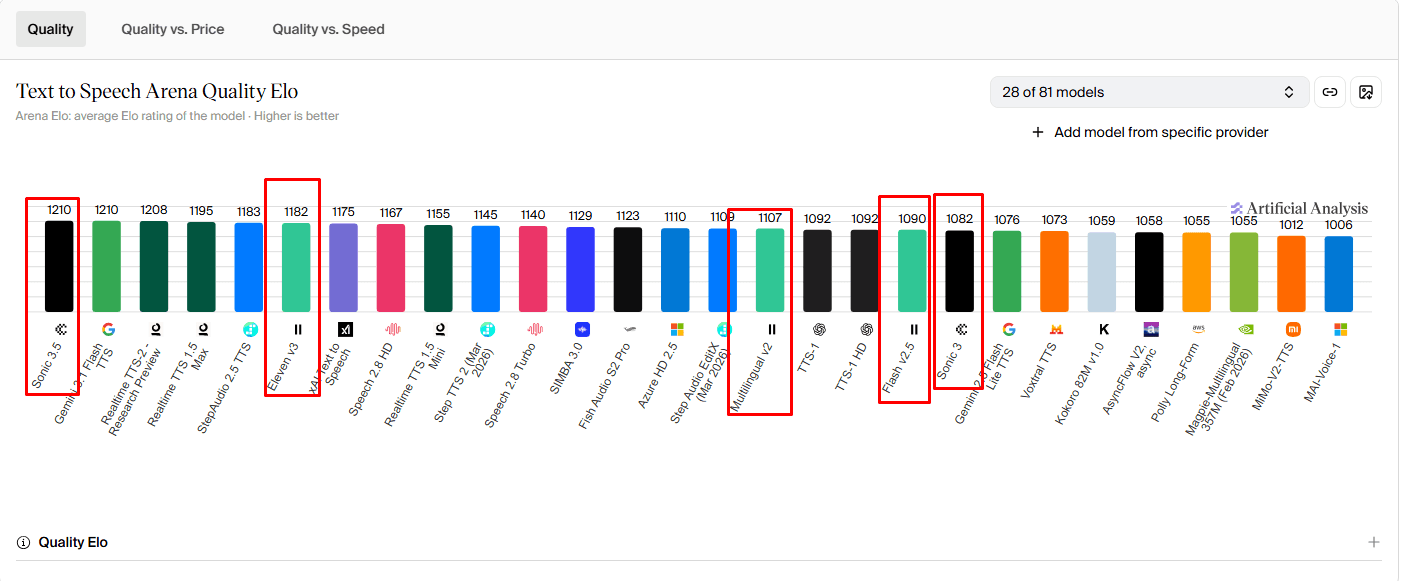
Model | Provider | Quality ELO |
|---|---|---|
Sonic 3.5 | Cartesia | 1,210 |
Eleven v3 | ElevenLabs | 1,182 |
Multilingual v2 | ElevenLabs | 1,109 |
Flash v2.5 | ElevenLabs | 1,090 |
Sonic 3 | Cartesia | 1,082 |
What this means:
Cartesia's newest model, Sonic 3.5, edges Eleven v3 in human preference votes, a notable result and a sign that Cartesia's quality ceiling is rising fast.
However, ElevenLabs fields three competitive models across the quality range (Eleven v3, Multilingual v2, Flash v2.5), giving teams more flexibility depending on latency and cost trade-offs. Sonic 3 Cartesia's production workhorse ranks below all three ElevenLabs models shown. The gap between Sonic 3.5 (1,210) and Eleven v3 (1,182) is 28 ELO points meaningful but not a blowout. Watch this space; Cartesia is closing the quality gap quickly.
Edge: Cartesia Sonic 3.5 (narrowly) on Quality ELO; ElevenLabs for model depth and flexibility across use cases
Source: artificialanalysis.ai/text-to-speech/models (independent, human-preference benchmark); ElevenLabs model documentation (elevenlabs.io/docs/overview/models); Cartesia Sonic product page (cartesia.ai/sonic)
Latency / Speed
Cartesia's SSM architecture leads on TTFA (time-to-first-audio): Sonic Turbo hits sub-40ms, Sonic-3 around 90ms. But on raw generation throughput characters produced per second the picture flips significantly.
Independent benchmark data from Artificial Analysis - Characters Per Second (higher is better):
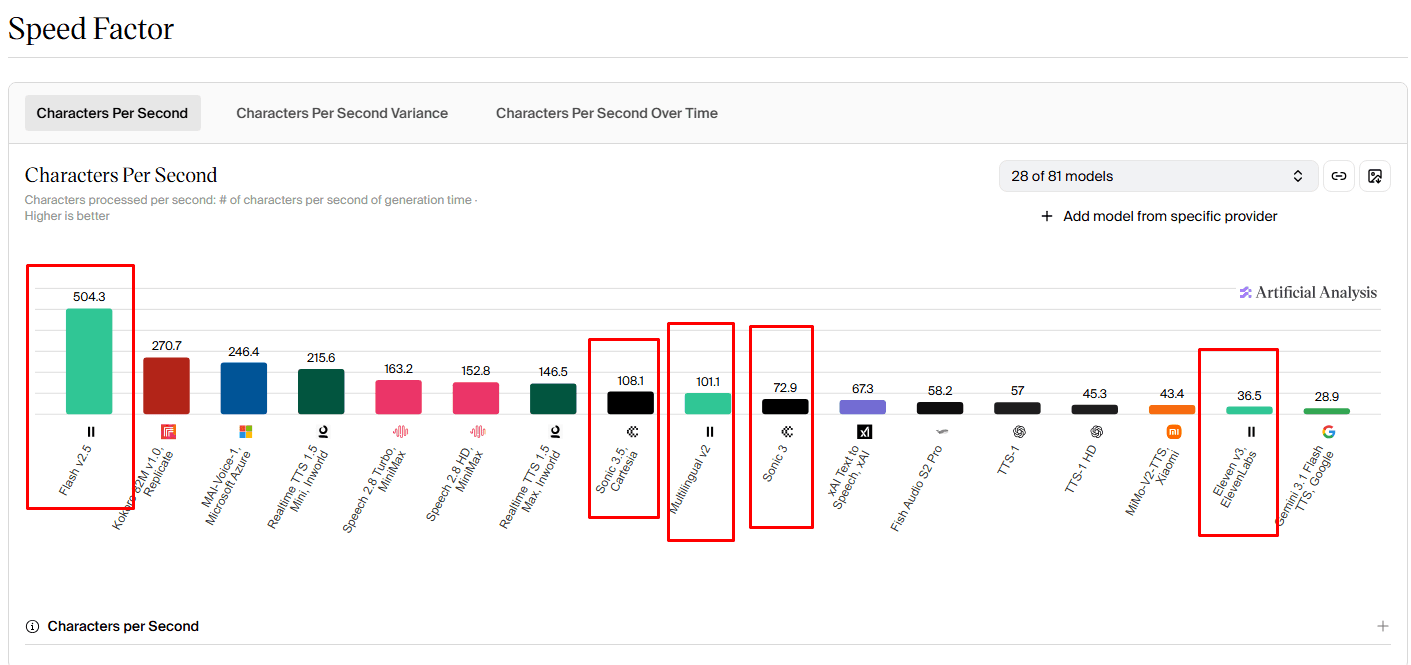
Model | Provider | Chars/sec |
|---|---|---|
Flash v2.5 | ElevenLabs | 504.3 🏆 #1 of 81 models |
Sonic 3.5 | Cartesia | 108.1 |
Multilingual v2 | ElevenLabs | 101.1 |
Sonic 3 | Cartesia | 72.9 |
Eleven v3 | ElevenLabs | 36.5 |
What this means:
ElevenLabs Flash v2.5 is the fastest TTS model tested by a massive margin. At 504.3 chars/sec it is nearly 5x faster than Cartesia Sonic 3.5 (108.1) and almost 7x faster than Sonic 3 (72.9). This matters differently depending on your use case. For real-time conversational agents, TTFA is what the user feels and Cartesia's architecture still wins there.
For batch content generation (audiobooks, dubbing, narration at scale), throughput is what drives cost and turnaround time, and Flash v2.5 is dominant. Eleven v3's 36.5 chars/sec reflects its prioritization of quality over speed it produces the most expressive output but takes longer to generate.
Edge: Cartesia for real-time TTFA; ElevenLabs Flash v2.5 for generation throughput (by a wide margin)
Source: artificialanalysis.ai/text-to-speech/models (independent benchmark); ElevenLabs TTS API page (elevenlabs.io/text-to-speech-api); Cartesia Sonic-3 docs (docs.cartesia.ai/build-with-cartesia/tts-models/latest)
Pricing (Independent Benchmark)
Independent benchmark data from Artificial Analysis - Price per 1M characters (lower is better):
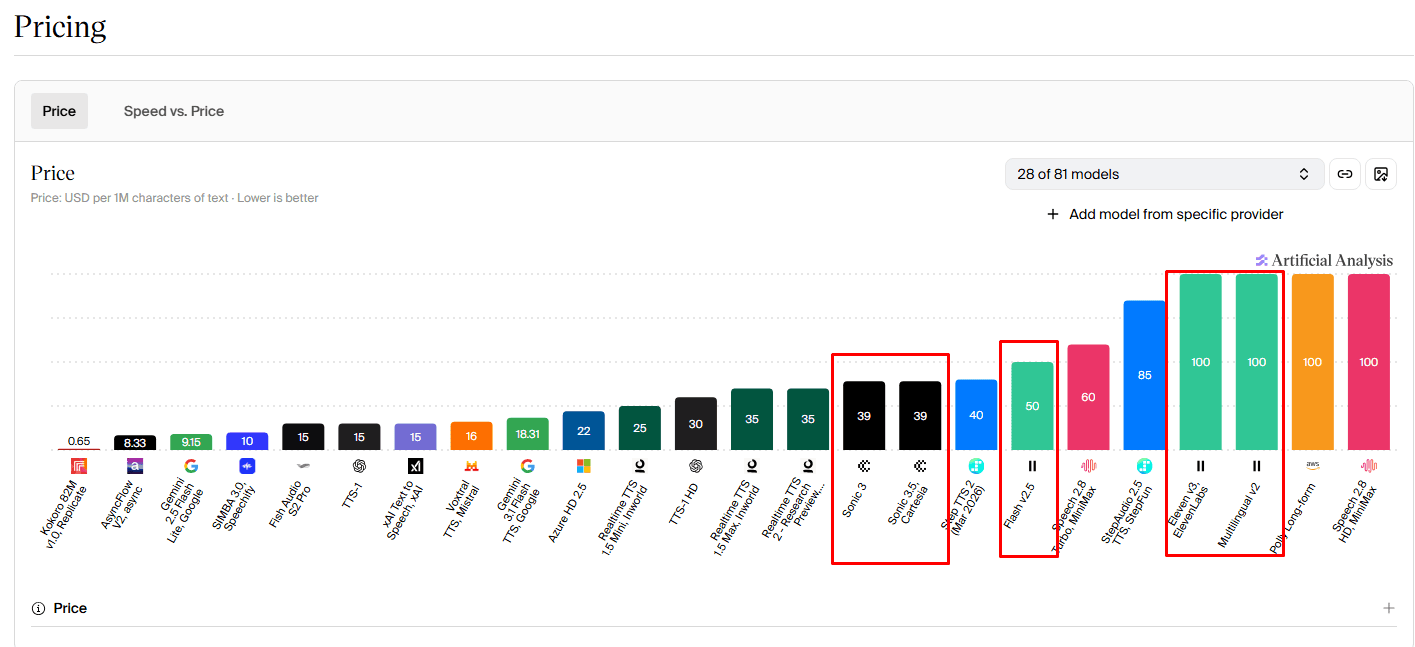
Model | Provider | $/1M chars |
|---|---|---|
Sonic 3 | Cartesia | $39 |
Sonic 3.5 | Cartesia | $39 |
Flash v2.5 | ElevenLabs | $50 |
Eleven v3 | ElevenLabs | $100 |
Multilingual v2 | ElevenLabs | $100 |
What this means:
Cartesia prices both Sonic 3 and Sonic 3.5 at $39/1M chars and Sonic 3.5 is currently the highest-quality model in the arena. That's a strong value proposition. ElevenLabs Flash v2.5 at $50/1M chars is the competitive mid-point fast, cost-efficient, and still ranked #4 in quality ELO among the models tested. The $100/1M rate for Eleven v3 and Multilingual v2 reflects their position as premium models.
For teams prioritizing quality-per-dollar, Cartesia Sonic 3.5 ($39, ELO 1,210) is the clear winner in this benchmark. For teams that need the full ElevenLabs ecosystem (STT, dubbing, agents), the blended cost picture shifts.
Edge: Cartesia on price-per-character across all model tiers
Source: artificialanalysis.ai/text-to-speech/models (independent benchmark)
Voice Cloning
ElevenLabs offers four tiers: Instant Clone (seconds of audio), Professional Voice Clone (30+ min), Voice Design (synthetic from scratch), and a licensed voice marketplace. The Professional Voice Clone is best-in-class for production fidelity. Cartesia offers Instant Clone from as little as 3 seconds of audio and a Pro Voice Clone option; their embedding technology handles noisy source audio well and preserves accents. Cartesia also offers unlimited instant clones, while ElevenLabs gates clone counts by plan tier.
Edge: ElevenLabs for Professional Clone quality; Cartesia for flexibility and unlimited instant clones Source: ElevenLabs voice cloning documentation (elevenlabs.io/docs); Cartesia vs. PlayHT comparison (cartesia.ai/vs/cartesia-vs-playht)
Language Support
ElevenLabs' Eleven v3 supports 70+ languages; Flash v2.5 and Turbo v2.5 support 32; Multilingual v2 supports 29. Cartesia's Sonic-3 supports 40+ languages covering approximately 95% of the world's speakers by population, with native voices per language. A significant improvement over earlier versions, though ElevenLabs still holds the edge in total language count and model depth per language.
Edge: ElevenLabs Source: ElevenLabs TTS API page (elevenlabs.io/text-to-speech-api); Cartesia Sonic product page (cartesia.ai/sonic)
API and Developer Experience
Both have solid REST APIs and SDKs. Cartesia's WebSocket streaming API is particularly clean for real-time audio and is the core of their offering. ElevenLabs' API surface is broader — covering TTS, STT, agents, dubbing, music and correspondingly more complex. Cartesia integrates natively with major orchestration platforms: Twilio, Pipecat, LiveKit, and Rasa, which matters a lot for teams building full voice agent stacks. ElevenLabs has its own agent runtime (ElevenAgents) with deep integrations across the product.
Edge: Cartesia for streaming/agent integrations; ElevenLabs for full-stack audio workflows Source: Cartesia documentation (docs.cartesia.ai); ElevenLabs documentation (elevenlabs.io/docs)
Pricing
Both platforms use credit-based billing tied to character count. The key difference: ElevenLabs has a more structured tier ladder with clearly published plan features; Cartesia is prepaid-credit-first and becomes less transparent at higher volumes.
ElevenLabs Pricing (2026)
ElevenCreative
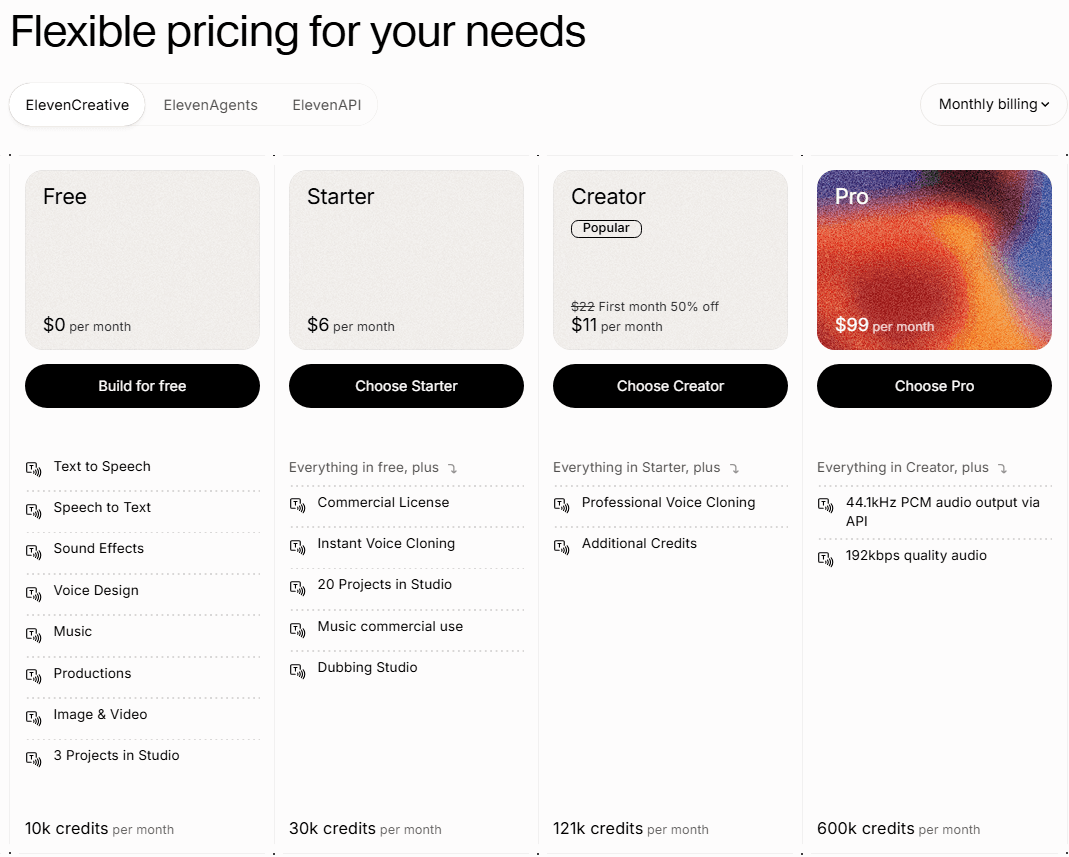
ElevenCreative (Business)
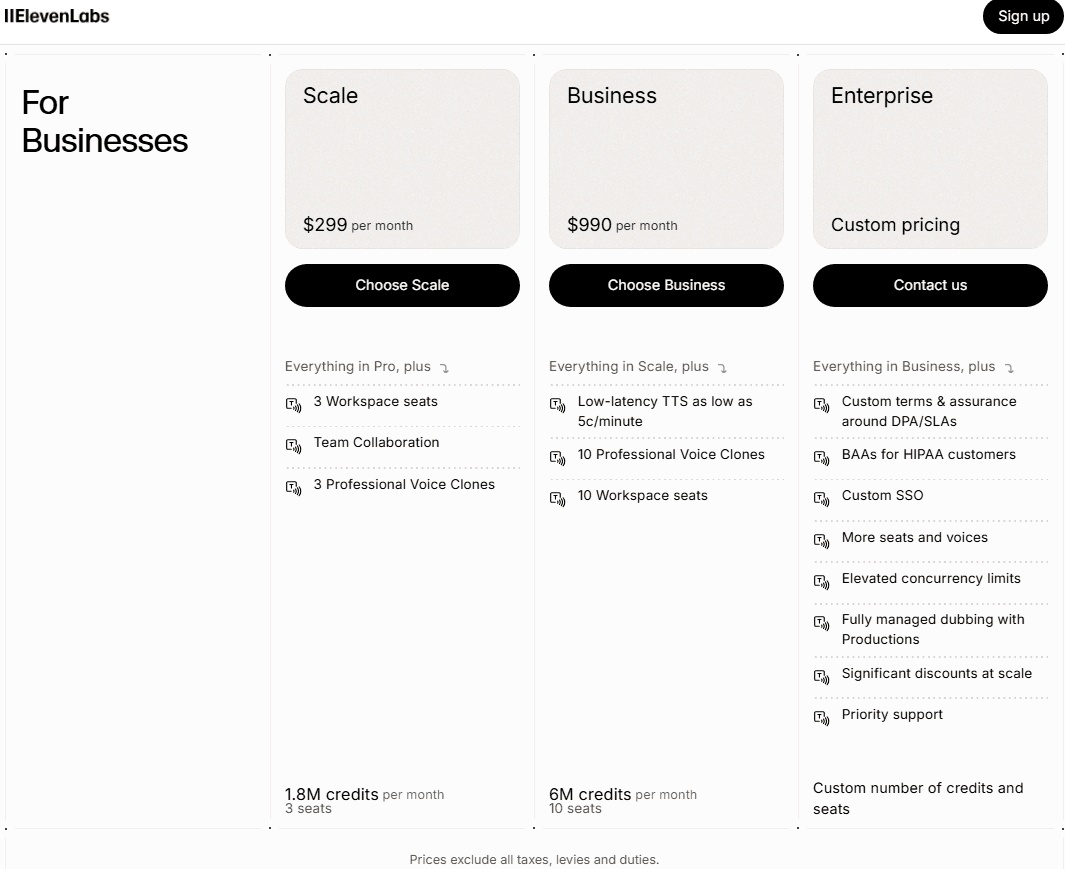
ElevenAgents
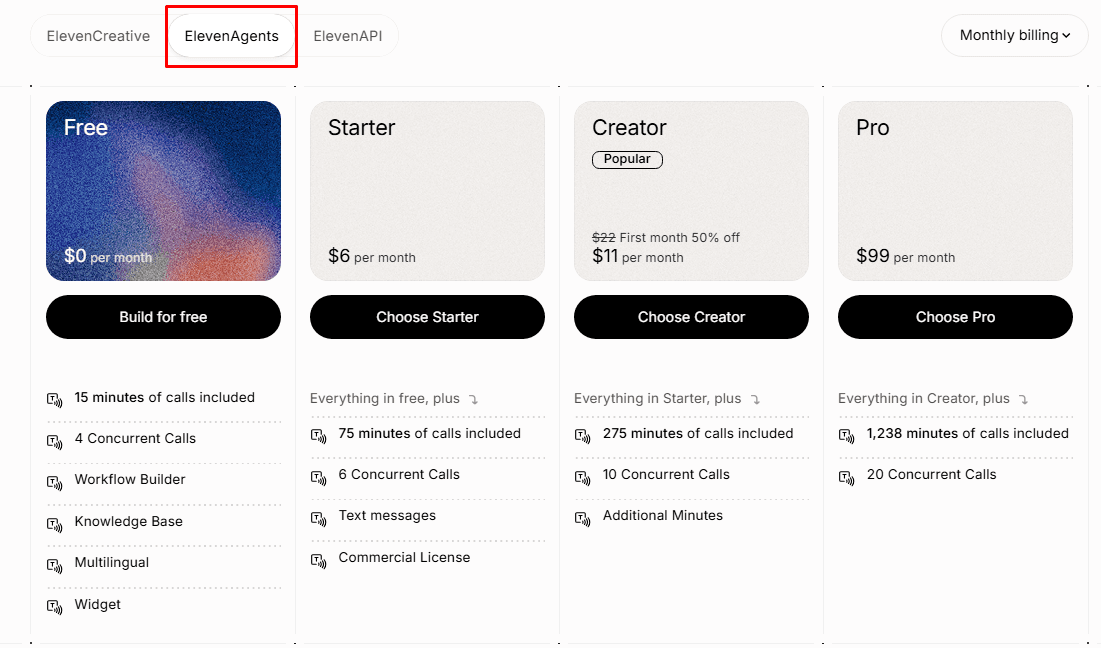
ElevenAgents (Business)
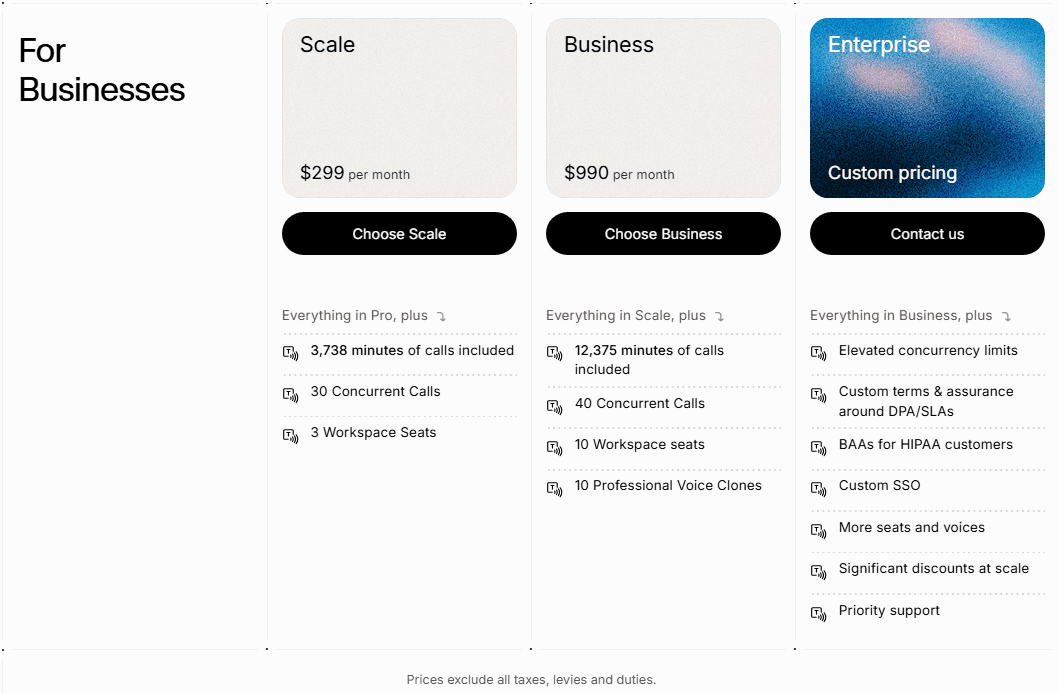
ElevenLabs API
Plan | Monthly Price | Best For |
Free / Pay-as-you-go | $0 | Testing; pay only for what you use |
Starter | $6/mo | Hobbyists; commercial use unlocked |
Creator | $22/mo (first month $11) | Podcasters, narrators; unlocks Professional Voice Cloning |
Pro | $99/mo | Agencies, high-volume content teams |
Scale | $299/mo | SaaS products, API integrations |
Business | $990/mo | Large-scale content operations |
Enterprise | Custom | Custom SLAs, SSO, HIPAA BAAs, on-prem |
ElevenLabs API - Text to Speech
Model | Rate | Free | Starter | Creator | Pro | Scale | Business |
Flash / Turbo | $0.05 / 1K chars | 20K chars | 120K chars | 440K chars | 1.98M chars | 5.98M chars | 19.8M chars |
Multilingual v2 / v3 | $0.10 / 1K chars | 10K chars | 60K chars | 220K chars | 990K chars | 2.99M chars | 9.9M chars |
Flash / Turbo: Ultra-low latency (~75ms), 32 languages, 40K character limit per request. Multilingual v2 / v3: Low latency (~250–300ms), high quality, 32 languages, 40K character limit per request.
ElevenLabs API Pricing - Speech to Text
Model | Rate | Entity Detection | Keyterm Prompting | Free | Starter | Creator | Pro | Scale | Business |
Scribe v1 / v2 | $0.22/hr | +$0.07/hr | +$0.05/hr | 4.5 hrs | 27 hrs | 100 hrs | 450 hrs | 1,359 hrs | 4,500 hrs |
Scribe v2 Realtime | $0.39/hr | — | — | 2.5 hrs | 15 hrs | 56 hrs | 254 hrs | 767 hrs | 2,538 hrs |
Scribe v1/v2: 98%+ accuracy, 90+ languages, keyterm prompting, dynamic audio tagging. Scribe v2 Realtime: ~150ms latency, 90+ languages, word-level timestamps, live transcription.
ElevenLabs API - Agents (Speech Engine)
Rate | Free | Starter | Creator | Pro | Scale | Business | |
Included minutes | — | 15 min | 75 min | 275 min | 1,238 min | 3,738 min | 12,375 min |
Additional minutes | $0.08/min | — | — | — | — | — | — |
Burst pricing | $0.16/min | — | — | — | — | — | — |
Concurrent calls | — | 4 | 6 | 10 | 20 | 30 | 40 |
Adds voice to your chat agent; leading models in a single pipeline, optimized for conversations, 70+ languages.
ElevenLabs API - Audio & Creative Tools
Product | Rate | Unit | Free | Starter | Creator | Pro | Scale | Business | Notes |
Music | $0.30 | per min | 3 min | 16 min | 62 min | 304 min | 1,100 min | 4,800 min | 5 min duration limit; $1.50/finetune; commercial use on Starter+ |
Voice Isolator | $0.12 | per min | 8.3 min | 50 min | 183 min | 825 min | 2,492 min | 8,250 min | Removes noise/reverb; WAV, MP3, FLAC, OGG, AAC; up to 500MB |
Voice Changer | $0.12 | per min | 8.3 min | 50 min | 183 min | 825 min | 2,492 min | 8,250 min | Real-time processing; 10K+ voices; 70+ languages |
Sound Effects | $0.12 | per generation | 8 | 150 | 605 | 3,000 | 9,000 | 30,000 | Royalty-free; MPS (44.1kHz) or WAV (48kHz) output |
Dubbing v1 | $0.33 | per min | — | — | — | — | — | — | Auto speaker detection; 29 languages; MP3, MP4, WAV, MOV |
How ElevenLabs credits work: 1 credit = 1 character on Multilingual v2/v3. Flash and Turbo models cost 0.5 credits/character, effectively doubling your output for the same plan. Conversational AI (ElevenAgents) is billed per minute, not per character. Unused credits roll over up to 2 months on paid plans. Annual billing saves ~17% (2 months free).
API rates (pay-as-you-go): ~$0.06–$0.12 per 1,000 characters depending on model. Eleven v3 runs ~$100/1M characters; Flash v2.5 runs ~$50/1M characters.
Source: https://elevenlabs.io/pricing
Cartesia Pricing (2026)
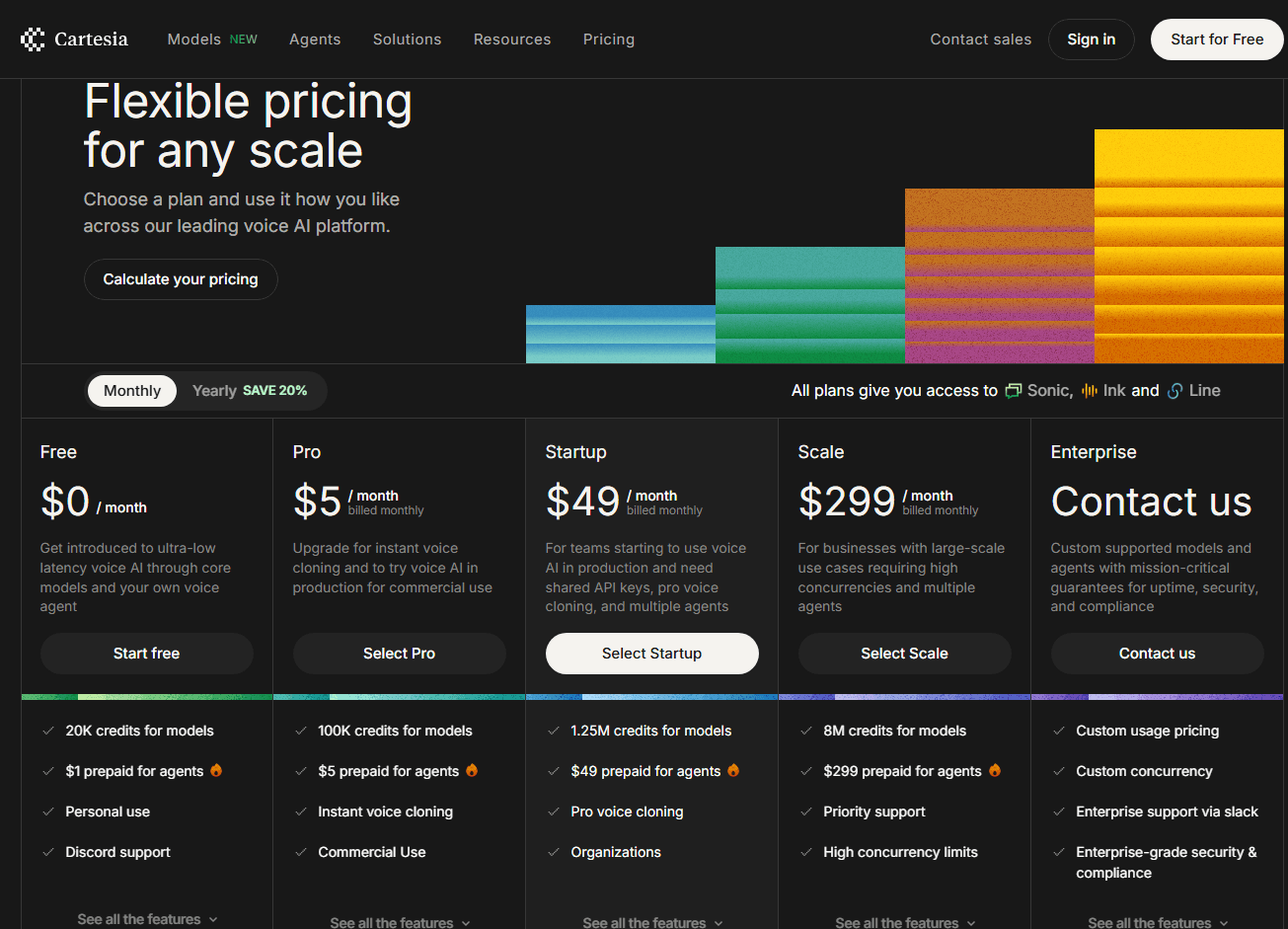
How Cartesia credits work: 1 credit = 1 character for standard TTS (Sonic). Pro Voice Cloning uses 1.5 credits/character after a one-time training fee. STT (Ink) is billed per second of audio. Voice agent calls via Line platform are billed at ~$0.06/minute. Concurrency limits (simultaneous streams) are a key differentiator across tiers — this matters for production telephony.
API rates: Sonic-3 runs ~$35/1M characters effective rate; Ink-Whisper STT runs ~$0.13/hour on Scale — among the cheapest streaming STT in the market.
Source: https://cartesia.ai/pricing
Both platforms use usage-based billing tied to character count. ElevenLabs publishes the most transparent API pricing page in the space, every model, every product, every tier. Cartesia uses a prepaid-credit model with agent billing kept separate.
Plan Tiers - Side by Side
ElevenLabs | Cartesia | |
Free | $0 · 10K credits | $0 · 20K credits + $1 agent prepaid |
Entry paid | $6/mo · 30K credits | $4/mo (yearly) · 100K credits + $5 agent prepaid |
Mid-tier | $22/mo · 121K credits (first month $11) | $39/mo (yearly) · 1.25M credits + $49 agent prepaid |
Production | $99/mo · 600K credits | — |
Scale | $299/mo · 1.8M credits · 3 seats | $239/mo (yearly) · 8M credits + $299 agent prepaid |
Business | $990/mo · 6M credits · 10 seats | — |
Enterprise | Custom · custom seats · HIPAA BAAs · SSO | Custom · custom concurrency · HIPAA · SSO · PCI |
Note: Cartesia prices shown are annual billing (20% discount). Monthly billing is higher. ElevenLabs prices are monthly; annual billing available.
Text to Speech (TTS)
ElevenLabs | Cartesia | |
Models | Flash v2.5 / Turbo · Multilingual v2 / v3 | Sonic-3 · Sonic-Turbo |
Latency | ~75ms (Flash) · ~250–300ms (Multilingual) | ~90ms (Sonic-3) · sub-40ms (Sonic-Turbo) |
Rate - fast model | $0.05 / 1K chars (Flash/Turbo) | 1 credit / char (see plan for $ rate) |
Rate - quality model | $0.10 / 1K chars (Multilingual v2/v3) | 1 credit / char (same rate) |
Languages | 32 (Flash) · 70+ (Multilingual v3) | 40+ |
Max request length | 40,000 chars | Not published |
TTS concurrent requests | Varies by plan | 2 (Free) · 3 (Pro) · 5 (Startup) · 15 (Scale) · Custom (Enterprise) |
Voice Changer | $0.12/min | 15 credits/sec of audio |
Voice Cloning - Instant | Included from Starter | No cost to clone · 1 credit/char generated |
Voice Cloning - Pro | Included from Creator | 1M credits to train · 1.5 credits/char generated |
Voice Design | ✅ | ✅ |
Infilling | ✅ | 300 credits (one-time) · 1 credit/char |
Speech to Text (STT)
ElevenLabs — Scribe | Cartesia — Ink | |
Models | Scribe v1/v2 · Scribe v2 Realtime | Ink-Whisper |
Rate | $0.22/hr (Scribe v1/v2) · $0.39/hr (Realtime) | 1 credit/sec of audio (~$0.13/hr on Scale) |
Latency | ~150ms (Realtime) | Fastest streaming STT in class |
Languages | 90+ | Multilingual |
Accuracy | 98%+ | Not published |
Extra features | Entity detection (+$0.07/hr) · Keyterm prompting (+$0.05/hr) · Word-level timestamps · Dynamic audio tagging | — |
Concurrent requests | Varies by plan | 8 (Free) · 12 (Pro) · 20 (Startup) · 60 (Scale) · Custom (Enterprise) |
Voice Agents
ElevenLabs - ElevenAgents / Speech Engine | Cartesia - Line | |
Rate - standard | $0.08/min | $0.06/min |
Rate - burst / overage | $0.16/min | $0.014/min (telephony) |
Text messages | $0.003/message | — |
Included minutes - Free | 15 min | $1 prepaid |
Included minutes - Entry | 75 min | $5 prepaid |
Included minutes - Mid | 275 min | $49 prepaid |
Included minutes - Production | 1,238 min | — |
Included minutes - Scale | 3,738 min | $299 prepaid |
Included minutes - Business | 12,375 min | — |
Concurrent calls - Free | 4 | 8 |
Concurrent calls - Mid | 10 | 20 |
Concurrent calls - Scale | 30 | 60 |
Concurrent calls - Business/Enterprise | 40 | Custom |
Agent slots | Unlimited (no cap stated) | 1 (Free) · 3 (Pro) · 5 (Startup) · 10 (Scale) |
LLM cost | Usage-based · billed at cost | Free for limited time (text-to-agent) |
Telephony | ✅ | ✅ |
Knowledge Base / RAG | ✅ | ✅ |
Workflow Builder | ✅ | ✅ (Reasoning templates) |
Evaluations | ✅ | ✅ (free for limited time) |
Text-to-Agent creation | ✅ | $0.05/creation |
Creative & Audio Tools (ElevenLabs only)
Product | Rate | Notes |
Music | $0.30/min | 5 min limit · $1.50/finetune · commercial use on Starter+ |
Voice Isolator | $0.12/min | Removes noise/reverb · WAV, MP3, FLAC, OGG, AAC · up to 500MB |
Sound Effects | $0.12/generation | Royalty-free · MPS 44.1kHz or WAV 48kHz |
Dubbing v1 | $0.33/min | Auto speaker detection · 29 languages · MP3, MP4, WAV, MOV |
Cartesia does not offer music, sound effects, dubbing, or voice isolation.
Compliance & Security
ElevenLabs | Cartesia | |
HIPAA | ✅ Enterprise (BAAs) | ✅ Enterprise |
SOC 2 Type II | ✅ | ✅ |
SSO | ✅ Enterprise | ✅ Enterprise |
PCI Compliance | Not stated | ✅ Enterprise |
On-prem / self-hosted | ✅ Enterprise (April 2026) | ✅ Enterprise + edge/on-device |
Custom SLAs | ✅ Enterprise | ✅ Enterprise |
Priority support | ✅ Enterprise | ✅ Scale + Enterprise (Slack) |
Bottom line on pricing:
Cartesia is cheaper per character for pure TTS, and its STT (Ink-Whisper) is the most cost-efficient streaming STT on the market.
ElevenLabs is more competitive when you factor in the breadth of bundled tools TTS, STT, agents, music, dubbing, voice isolation, all under one subscription. For agent-heavy workloads, Cartesia's concurrent call limits are more generous per tier. For content production, ElevenLabs has no comparison.
Edge: Cartesia for pure TTS/STT cost at scale and agent concurrency; ElevenLabs for all-in-one platform value
Sources: elevenlabs.io/pricing · elevenlabs.io/pricing/agents · elevenlabs.io/pricing/api · cartesia.ai/pricing
Ecosystem and Tooling
ElevenLabs | Cartesia | |
Platform philosophy | All-in-one audio AI platform for creators, developers, and enterprises | Developer-first, code-first voice AI stack optimized for agents |
TTS | ✅ Flash/Turbo, Multilingual v2/v3, Eleven v3 · 70+ languages | ✅ Sonic-3, Sonic-Turbo · 42 languages · laughter + emotion tags |
STT | ✅ Scribe v1/v2, Scribe v2 Realtime · 90+ languages · 98%+ accuracy | ✅ Ink-Whisper · lowest time-to-complete-transcript · noisy audio tested |
Voice Agents | ✅ ElevenAgents- no-code/low-code builder, workflow builder, knowledge base, RAG, telephony, guardrails, multilingual | ✅ Line — code-first SDK, multi-prompt config, tool calling, RAG, background agents, GitHub integration, CLI, observability |
Voice Cloning | ✅ Instant Clone · Professional Voice Clone · Voice Design · Voice Library (10K+ voices) | ✅ Instant Clone (no cost) · Pro Voice Clone (1M credits to train) · Voice Library |
Voice Changer | ✅ Real-time · 10K+ voices · 70+ languages | ✅ Available (15 credits/sec) |
Music Generation | ✅ AI Music Generator (text to music) | ❌ Not offered |
Sound Effects | ✅ Text to Sound Effects · royalty-free | ❌ Not offered |
Voice Isolator | ✅ Background noise removal · up to 500MB files | ❌ Not offered |
Dubbing | ✅ AI Dubbing · 29 languages · auto speaker detection | ❌ Not offered |
Image Generation | ✅ AI Image Generator | ❌ Not offered |
Video Generation | ✅ AI Video Generator | ❌ Not offered |
Studio / Long-form | ✅ Studio (audiobook + long-form production environment) | ❌ Not offered |
Infilling | ❌ Not offered | ✅ Mid-speech insertion (300 credits one-time + 1 credit/char) |
Text-to-Agent | ✅ Available | ✅ Available (generates agent code from a prompt · $0.05/creation) |
Third-party integrations | ✅ Twilio, Pipecat, LiveKit, Rasa, Salesforce, Cisco Webex, and more | ✅ Twilio, Pipecat, LiveKit, Rasa, and other orchestration platforms |
GitHub integration | ✅ | ✅ One-click deploy + scaling |
Observability / Logs | ✅ 14-day call history · 30-day chat history | ✅ Full call logs via CLI and dashboard |
Startup grants | ✅ 12 months free · 33M characters | Not published |
On-prem / self-hosted | ✅ Enterprise (April 2026) | ✅ Enterprise + edge/on-device co-location |
Primary audience | Creators, marketers, publishers, enterprise CX teams, developers | Developers and product engineers building real-time voice agents |
ElevenLabs is the broader platform by a significant margin. If your use case touches content creation, audiobooks, dubbing, music, video, sound effects there is no comparison. ElevenAgents also supports non-technical users through a no-code builder, which Cartesia's Line explicitly does not.
Cartesia's Line is purpose-built for engineers. Code-first, CLI-driven, GitHub-integrated, with multi-prompt configuration and background agent support baked in. For a developer who wants fine-grained control over every layer of their voice agent stack, Line is a cleaner environment than ElevenAgents.
Edge: ElevenLabs for breadth; Cartesia for developer control in agent-specific workflows
Source: elevenlabs.io · elevenlabs.io/agents · cartesia.ai · cartesia.ai/agents
Compliance and Security
ElevenLabs | Cartesia | |
SOC 2 Type II | ✅ Certified (zero exceptions) | ✅ Certified |
ISO 27001 | ✅ Certified | Not published |
PCI DSS Level 1 | ✅ Certified | ✅ Enterprise |
HIPAA | ✅ BAAs for qualifying enterprises; requires Zero Retention Mode | ✅ Enterprise |
GDPR | ✅ Full compliance; EU data residency available | Not explicitly published |
CCPA | ✅ | Not explicitly published |
Data residency | ✅ US, EU, and India options (Enterprise) | Not published |
Zero Retention Mode | ✅ Optional; audio inputs/outputs not stored after processing | Not published |
End-to-end encryption | ✅ Data in transit and at rest | Not published |
Custom SSO | ✅ Enterprise | ✅ Enterprise |
Custom SLAs | ✅ Enterprise | ✅ Enterprise |
On-prem / self-hosted | ✅ Enterprise (launched April 2026) | ✅ Enterprise + edge/on-device co-location |
DPA available | ✅ Published at elevenlabs.io/dpa | Not published |
Trust Center | ✅ compliance.elevenlabs.io | Not published |
Custom security review | ✅ Enterprise | ✅ Enterprise |
Forward Deployed Engineers | ✅ Available for large enterprise deployments | Not offered |
Both platforms cover the compliance basics that enterprise buyers need: SOC 2 Type II, HIPAA, PCI, and SSO. The difference is depth and documentation.
ElevenLabs has expanded its stack to include ISO 27001 and PCI DSS Level 1 certifications, a published Trust Center, a publicly available DPA, Zero Retention Mode (audio not stored after processing), and regional data residency across the US, EU, and India. HIPAA support requires Zero Retention Mode to be active and a BAA to be signed, worth knowing if you're building in healthcare.
Cartesia confirms SOC 2 Type II and HIPAA at the Enterprise tier, and PCI is listed as an Enterprise feature, but they don't publish the same depth of compliance documentation.
For teams in regulated industries healthcare, financial services, legal, government, ElevenLabs' compliance posture is more thoroughly documented and easier to verify in a procurement process. Cartesia covers the essentials but requires more back-and-forth with their sales team to get the same level of assurance.
Edge: ElevenLabs Source: elevenlabs.io/enterprise · elevenlabs.io/agents/ai-trust-and-reliability · elevenlabs.io/docs/overview/administration/data-residency · cartesia.ai/pricing
Pros and Cons
ElevenLabs | Cartesia | |
Voice Quality | ✅ Best-in-class; Eleven v3 sets the expressive ceiling | ✅ Solid (MOS 4.7); lags behind ElevenLabs' top models |
Latency (TTFA) | ⚠️ ~75ms (Flash v2.5); closing the gap | ✅ ~40ms (Turbo) / ~90ms (Sonic-3); architecture-level advantage |
Voice Cloning | ✅ Professional Clone is best-in-class; tiered clone limits | ✅ Unlimited instant clones; 3-second cloning; handles noisy audio |
Language Support | ✅ 70+ languages (Eleven v3); 32 (Flash v2.5) | ✅ 40+ languages; 95% of world speakers covered |
API / DX | ✅ Rich feature set; steeper learning curve | ✅ Clean, focused; excellent streaming API; native orchestration integrations |
Pricing | ⚠️ Predictable on lower tiers; can scale steeply with premium features | ✅ More cost-predictable at high volume |
Ecosystem | ✅ Full audio platform: agents, dubbing, music, STT, audiobooks | ⚠️ API-first; thinner product surface beyond core TTS/STT/agents |
Compliance | ✅ Enterprise options; IBM watsonx partnership | ✅ SOC 2 Type 2, HIPAA, on-prem deployment |
Company Scale | ✅ ~580+ employees; $11B valuation; $500M ARR | ⚠️ ~50–116 employees; $191M raised; early-stage growth |
Real-Time Agents | ⚠️ ElevenAgents improving; Flash v2.5 competitive | ✅ Purpose-built for this; best TTFA in the market |
Content Production | ✅ Best platform for audiobooks, dubbing, narration | ⚠️ Works but not the focus |
How to Actually Choose
Answer one question: does your user need to wait for the audio to start, or is a 300ms pause acceptable?
If they can't wait, use Cartesia. Voice assistants, phone agents, real-time tutors, anything conversational where every millisecond of delay erodes trust.
If they can wait, or if there's no real-time interaction at all, use ElevenLabs. Narration, content creation, audiobooks, dubbed video, expressive characters, any pre-rendered audio.
One important update: ElevenLabs' Flash v2.5 at ~75ms is now genuinely competitive for many real-time use cases. If you want ElevenLabs' voice quality and can architect around Flash v2.5, the latency gap has narrowed enough that some teams are making it work. But if your stack is latency-sensitive and you're routing production telephony traffic, Cartesia's architecture still holds the structural advantage.
If you're not sure yet, start with ElevenLabs. The quality will impress stakeholders, the tooling is more complete, and you can always swap in Cartesia's API once latency becomes a problem. The reverse swap is harder to justify once users are already attached to a specific voice.
Real-World Examples
A customer service bot at a fintech company switched from ElevenLabs to Cartesia after finding that their average TTS latency was contributing to call abandonment. After moving to Cartesia's streaming API, their time-to-first-audio dropped dramatically. Callers stopped noticing the AI delay.
On the other side: a podcast production team using Cartesia for synthetic narration segments switched to ElevenLabs after receiving listener feedback about the voices sounding "slightly off." The quality difference was subtle but consistent, and once listeners noticed it, they started noticing everything.
Both platforms did what they were built to do. Neither failed. The teams just had to learn which dimension of performance their users actually cared about.
Expert Perspective
"Voice latency is the uncanny valley of real-time AI. Users don't consciously notice 90ms vs 300ms, but they feel it. The response feels slower, the conversation feels less natural, and trust erodes over the course of the interaction." This reflects a widely shared view among voice AI developers building real-time agents in 2025 and 2026, where latency has become the primary competitive differentiator at the infrastructure layer.
Is ElevenLabs better than Cartesia for voice cloning?
Can Cartesia match ElevenLabs' voice quality?
Which is better for building AI voice agents?
Do both platforms support streaming?
What about pricing at scale?
Does Cartesia support speech-to-text?
Does ElevenLabs support speech-to-text?
The Bottom Line
Pick Cartesia if your product lives or dies on response speed, or if you need the cleanest possible integration with agent orchestration platforms like LiveKit, Pipecat, or Twilio.
Pick ElevenLabs if voice quality, expressiveness, a full audio ecosystem, or language coverage drives your outcome. The February 2026 funding round and 50% price cut have also made it significantly more competitive on cost.
If you're still prototyping, ElevenLabs is the better starting point. Eleven v3's quality will impress stakeholders, the tooling is more complete, and you can always migrate latency-critical paths to Cartesia or ElevenLabs Flash v2.5 once you know where the bottlenecks are.
The gap is narrowing on both sides. Cartesia's quality is improving; ElevenLabs' latency is dropping. But right now, they're still genuinely different products built for different outcomes. Choose accordingly.

References:
ElevenLabs model documentation, elevenlabs.io/docs/overview/models (2026)
ElevenLabs TTS API page, elevenlabs.io/text-to-speech-api (2026)
ElevenLabs pricing page, elevenlabs.io/pricing (2026)
Cartesia Sonic-3 product page, cartesia.ai/sonic (2026)
Cartesia Sonic-3 documentation, docs.cartesia.ai/build-with-cartesia/tts-models/latest (2026)
Cartesia vs. OpenAI TTS latency comparison, cartesia.ai/vs/cartesia-vs-openai-tts (2026)
Cartesia pricing page, cartesia.ai/pricing (2026)
Sacra: ElevenLabs revenue and ARR analysis, sacra.com (April 2026)
Tracxn: ElevenLabs and Cartesia company profiles, tracxn.com (April 2026)
Google/Deloitte research on mobile speed and conversion rates (2023), Think with Google
TIME: Mati Staniszewski, The 100 Most Influential People in AI 2025